L.B.I.B.Y.C. Multimedia News and Features
Updated 3/16/10
L.B.I.B.Y.C. Multimedia News and Features
Updated 3/16/10
Garden State saltwater recreational anglers, especially boaters, this season will be subject to often confusing and changing fishing regulations thanks to new federal and New York state angling laws. But there is a way to kill two annoying birds with one stone.
The bad news, there is yet another fishing regulation. Just about all recreational tidal and saltwater fishermen will have to sign up for the
national saltwater registry or have other licensees or permits this year before they cast their lines in the salty sea.
Although there is no New Jersey law yet requiring a saltwater license if your boat intentionally or accidentally drifts into New York waters while you are fishing, with with few exceptions, you will now need to have a non resident New York saltwater license.
The good news, if you can call it that, is that if you purchase the New York non resident license, you will NOT be required to sign up for the new national registry for saltwater anglers according to the National Oceanic and Atmospheric Administration who runs the program.
NOAA spokesman Forbes Darby said as long as one has a non resident saltwater license from any of the federally approved states that are listed on their website http://countmyfish.noaa.gov which includes New York, you will not be required to sign up for the national registry.You also do not have to sign up for the registry if you hold a federal Migratory Species Angling Permit (known to locals as a tuna permit) which is required if you fish for tuna, shark and other big game migratory fish. But that doesn’t apply to other fisherman on your boat.
Both the federal and New York laws exempt you if you are fishing on charter, head, or guide boats provided they have their permits.
The New York license and the national registry rules are very similar.Under the national registry, if you are not one of the exempted fishermen,( see the NOAA site listed below this article for all the exceptions) you must sign up if you fish three miles off shore in saltwater, or you fish in tidal or saltwater for migratory species like striped bass.
NOAA’s Darby, who narratives the movie left, explained that technically the law also applies to fishing on inshore New Jersey salt waters because if you hook up a striped bass or any other migratory fish, whether you keep it or release it, you will be in violation of the new federal law if you have not signed up.
Bottom line to all these confusing rules Darby admitted is that now just about everyone fishing in saltwater in New Jersey needs to sign up for the national registry or get a non resident saltwater license, like NewYork’s, for themselves and anyone fishing on their boat.
NEW FEDERAL AND NEW YORK STATE LAWS
WILL IMPACT NEW JERSEY SALTWATER ANGLERS
New Jersey Saltwater Anglers Do NOT have to sign up for the National Registry if they hold a non resident New York Saltwater License or a Federal Tuna Permit
The idea behind the new registry is so NOAA can estimate fish counts and the health of coastal fisheries for better management. The registry is free this year, but next year it will cost you, although so far they can’t say how much.
Because the national registry is “new and confusing to many anglers,” Darby said NOAA will stress educating fisherman this year rather than fines, and will in most cases enforcement officers only hand out warnings for first time offenders.
New York has not made such promises. If you have ever been boarded by New York authorities, you know that fines are more likely than a warning. If you are in what New York considers its territorial waters, with a few exceptions, and you do not have a $15 dollar non resident license you and everyone on your boat without the state license are subject to a fine of up to $250 and/or 15 days in jail, the DEP said.
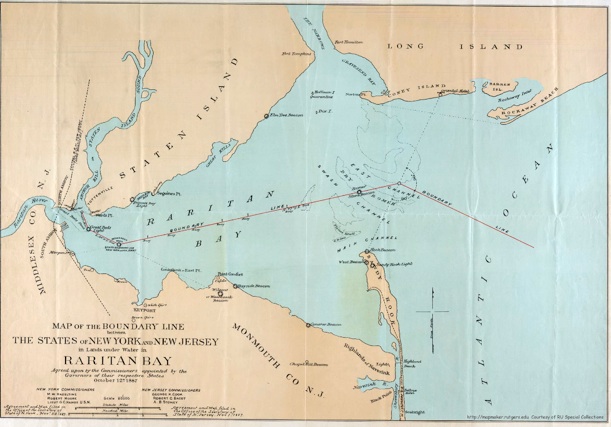
To make this all the more confusing for north Jersey anglers, the line drawn in the water separating New York territorial waters from New Jersey’s has been a matter of debate for years inside and outside the court room.
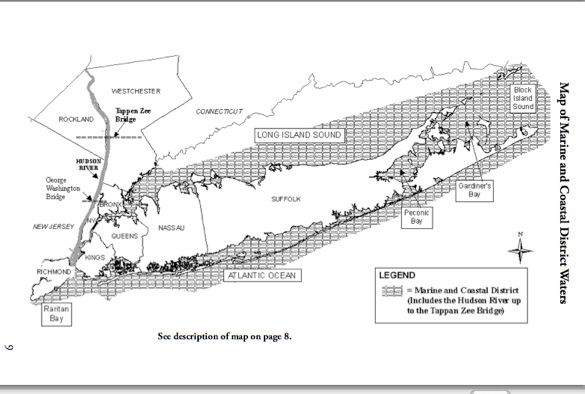
According to New York’s Recreational Marine Fishing Regulations Guide: “The marine and coastal district includes the Atlantic Ocean within three nautical miles from the coast and all tidal waters within the state up to the Hudson River to the Governor Malcolm Wilson Tappan Zee Bridge.
Although not included ... the marine license also applies to the Hudson River, Delaware River, and Mohawk River and their tributaries for when a person is fishing for “migratory fish of the seas”, such as striped bass, American shad, hickory shad, blueback herring and alewife”
Along with this statement in the guide is a map of the territorial waters, ( seen left) but it is not specific enough to note boundary lines by GPS coordinates, buoys, or by channels which would make it easier for boaters to understand what state their in while at sea.
When the New York State DEP was asked for more boater friendly information on the boundaries they provided an almost 6,000 word law that was written in 1880 that refers to charts from the same period full of enough legal jargon to keep a bevy of lawyers busy.
Above, chart of New York territorial salt waters found in their Fishing and Marine Regulation guide
New Jersey DEP was also asked if they could define the boundaries in terms fishermen could easily understand. They said they’d try. When and if they do, their boundary definition will be published here. But you must keep in mind -- New York enforcement officers may not agree with the Garden State’s interpretation of the boundaries.
The New York DEP also provided a chart from 1887 ( seen left) which has the boundaries on it, but doesn’t include latitude and longitude lines to locate yourself via GPS.
So, the bottom line is: if you want to be sure to avoid a fine for wandering into New York waters, (1) pay the 15 bucks for the NY license and (2) be sure everyone on your boat has a NY license.
But, even if you have the New York non resident license, there is another annoying glitch between the fishing regulations of New York and New Jersey you must consider.

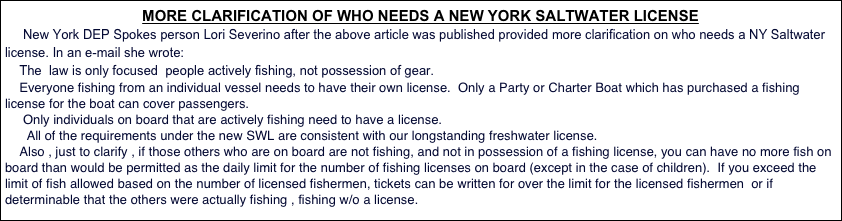
According to a spokes person for the NY DEP, Lori Severino, any fish that are on your boat or person while in New York territorial waters or within their land locked boundaries must meet the seasonal rules, size and possession limits of New York State, even if they were caught in New Jersey waters.
So even if you get that NY non resident license beware because there are some significant differences in New York and New Jersey fishing regulations that could get you in trouble.
For example, under the present New Jersey regulations you can keep six fluke 18 inches or over. But if you happen to wander into New York water with those fish in your cooler and get boarded, you could be fined since New York restricts the limit on fluke to only two fish at 21 inches or over -- even though they were caught in New Jersey!
And if that is not all you have to figure out, coming soon there may be a new New Jersey fishing saltwater seasons as well as size and possession limits. According to NJ DEP spokeswoman Darlene Yuhas, the New Jersey Fishing Digest coming out in May will outline any changes or new regulations. She said the digest will be available at many fishing and sporting good stores through out the state. Or it can be downloaded from the the DEP website link listed below.
For more detailed information about state and federal saltwater regulations and exemptions listed below are a few government links that might help you navigate through the fog of all these new fishing laws.
New Jersey Marine Fisheries Digest -- 2009
The 2010 edition available in May